
117 Entertainment
- July 20, 2026
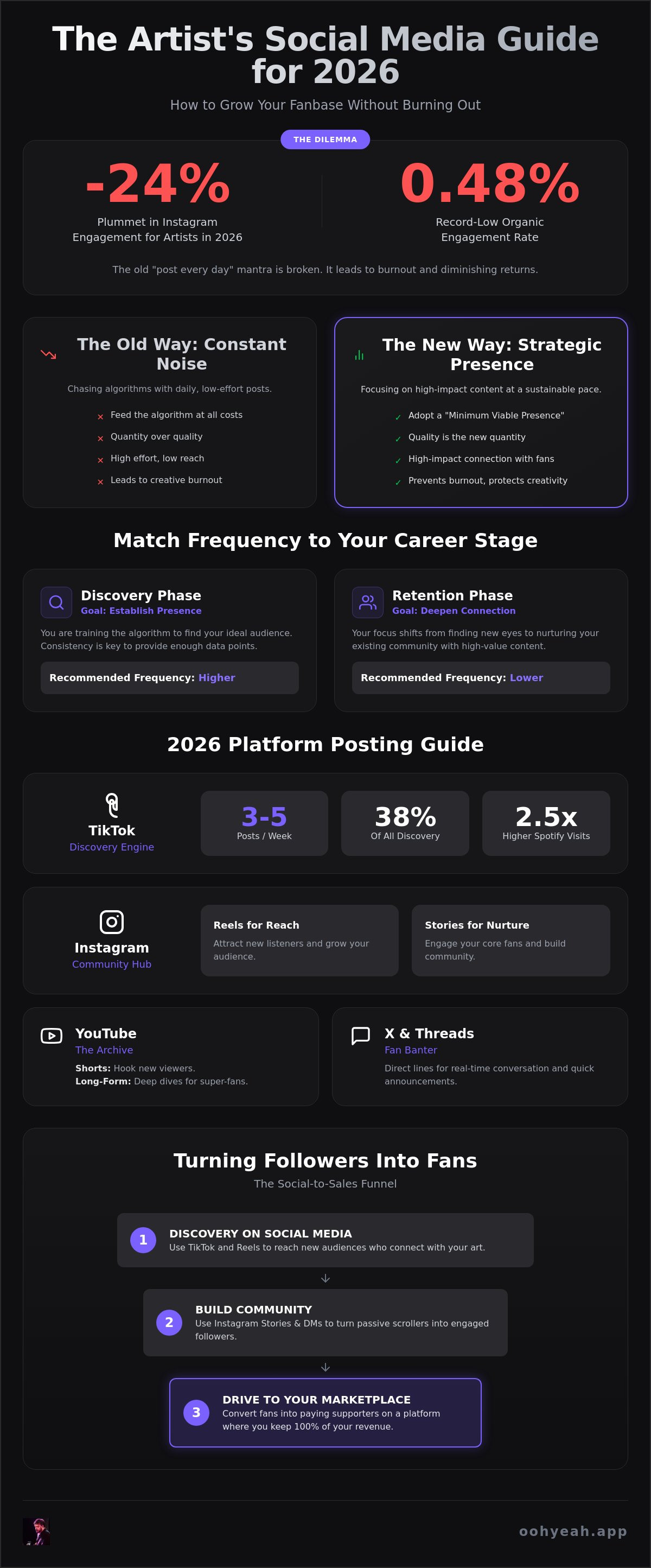
Did you know that Instagram engagement rates for artists plummeted by 24% in 2026, hitting a record low of just 0.48%? It is no wonder you feel like a hamster on a wheel. You are likely asking, How Often Should Artists Post on Social Media? just to stay visible in a sea of AI-generated content. Most creators spend more time editing reels than actually making art, yet the rewards keep shrinking. It is exhausting to play the role of a full-time content creator when your true passion is your craft.
We agree that the current system is broken. You shouldn't have to sacrifice your creativity to feed an algorithm that barely recognizes you. This guide will show you how to take back control. You will discover the exact posting frequencies for every major platform to grow your fanbase without burning out. We are moving beyond the Discovery Era and into the Community Era, where strategic presence beats constant noise. We will break down a manageable schedule that turns passive scrollers into paying supporters on platforms where you keep 100% of your revenue.
Key Takeaways
- Define a sustainable posting rhythm that prevents burnout and keeps your creative energy focused on your art rather than just the algorithm.
- Discover the 2026 platform-specific answers to How Often Should Artists Post on Social Media? to ensure your content actually reaches new fans.
- Implement the Minimum Viable Presence (MVP) framework to maintain high impact on TikTok and Instagram with significantly less effort.
- Learn how to bridge the gap between social media discovery and real financial independence by driving traffic to your own commission-free marketplace.
- Shift your strategy from passive consumption to community building, turning low-value followers into dedicated supporters who buy your digital downloads and merch.
The Social Media Frequency Dilemma for Artists in 2026
The old "post every day" mantra is officially dead. In 2026, following that outdated advice is the fastest way to hit a wall of massive artist burnout. You are an artist, not a content factory. When you force yourself to churn out daily updates just to stay relevant, your creativity suffers. Your audience feels that lack of soul, and the algorithm notices too. This creates a cycle where you work harder for fewer views.
Success now depends on Sustainable Frequency. This is the rhythm that maintains your growth without compromising your artistic output. You must find a pace that feels like a natural extension of your work, not a second job. If you are constantly asking, How Often Should Artists Post on Social Media?, the answer starts with your own capacity. Posting three high-quality pieces of content a week is infinitely better than seven low-effort updates that nobody cares about.
The shift from chronological feeds to AI-driven interest graphs changed everything. Timing matters far less than relevance in 2026. Platforms now function like search engines that prioritize context and keywords. If your content is boring, it carries a high cost. Low-value posting kills your reach faster than ghosting your followers for a month. Every time a user scrolls past your post without engaging, the AI learns to show them less of your work in the future.
Why 'Feeding the Algorithm' is a Losing Game
Algorithms prioritize watch time and deep engagement over pure frequency. If you flood the feed with uninspired content, you risk "shadow-suppression." This happens when your audience stops engaging because they are bored, signaling the AI to bury your profile. A smart Content marketing strategy focuses on quality as the new quantity. In 2026, AI-curated discovery feeds only reward content that earns every second of the viewer's attention.
Defining Your Artist Career Stage
Your posting volume should depend on your current goals. Artists in the Discovery Phase generally need a higher frequency to establish their presence. This is because you are undergoing "algorithmic training," which is the process of consistently providing the AI with enough data to understand exactly who your ideal audience is and where to place your content. Once you reach the Retention Phase, you can post less often. At this stage, your focus shifts to high-impact connection rather than just hunting for new eyes. When considering How Often Should Artists Post on Social Media?, remember that your stage of growth dictates your workload.
Platform-Specific Posting Guides: TikTok, Instagram, and Beyond
Every platform demands a different sacrifice. You cannot copy-paste your way to success in 2026. When asking How Often Should Artists Post on Social Media?, you must look at each platform's specific role in your career. TikTok is your discovery engine. Instagram is your community hub. YouTube is your archives. Understanding these roles allows you to post with purpose instead of desperation. Stop guessing and start measuring what actually moves the needle for your music.
TikTok is no longer just a video app. It is the dominant search engine for music discovery. In 2026, TikTok drove 38% of all social media-attributed discovery for younger audiences, proving its power to capture new fans. You should aim to post 3 to 5 times per week here. Statistics from March 2026 show that artists maintaining this frequency see 2.5 times higher Spotify profile visits compared to those posting once a week. This rhythm keeps the algorithm trained on your sound without draining your creative battery.
Instagram remains a tale of two worlds. Reels help you find new ears, while Stories keep the fans you already have. Because organic engagement hit a historic low of 0.48% in 2026, you must be strategic with your feed. YouTube remains the gold standard for super-fans. Use Shorts to hook them and long-form video to let them dive deep into your creative process. Even text-based apps like X and Threads have a role, serving as direct lines for real-time fan banter and music PR announcements.
Short-Form Video: The Growth Engine
The impact of social media on music promotion is undeniable, but the "hook" is everything. The first 3 seconds of your video determine your reach. Don't overthink production. Turn one studio session into 5 pieces of content: a gear walkthrough, a vocal take, a lyric reveal, a "get ready with me" clip, and a final preview. Aim for a "Golden Ratio" of 70% music-focused content and 30% personality-driven clips to build a human connection that lasts.
Instagram Stories: The Retention Secret
Feed posts are for discovery, but Stories are for survival. You should post to your Stories daily. It is the best way to bypass the low organic reach of the main feed and stay top-of-mind. Use polls and stickers to gather data. Ask your fans what merch designs they like or which digital downloads they want next. This raw access builds the trust needed to turn a follower into a customer. When you decide How Often Should Artists Post on Social Media?, remember that consistency in Stories is what builds your direct-to-fan marketplace income.
Quality vs. Quantity: Identifying the Tipping Point of Burnout
Quantity does not lead to quality. If you are constantly stressing over How Often Should Artists Post on Social Media?, you are likely missing the point. The Minimum Viable Presence (MVP) framework is designed to keep you visible without draining your soul. It focuses on doing just enough to remain relevant while prioritizing your creative output. You must learn to spot the signals of burnout early. If opening an app feels like a chore rather than a connection, it is time to scale back. Your art is the priority, not the platform.
The benefits and drawbacks of social media are a constant balancing act for creators. While these platforms offer a stage, they can also become a cage. When you stop worrying about How Often Should Artists Post on Social Media? and start focusing on the 80/20 rule, your stress levels will drop. Roughly 20% of your content will generate 80% of your fan conversions. Identify those high-performing posts and double down on them. Don't be afraid of a strategic break. Stepping away for a week can actually reset your engagement and allow you to return with a fresh perspective that resonates more deeply.
Batching: The Only Way to Survive the Feed
Stop creating content every single day. It is a recipe for disaster. Set aside 4 hours once a month to batch your content. By 2026, smart artists are using AI tools like KOPY AI to handle the heavy lifting of social media tasks while maintaining their unique voice. Organize your posts into three content pillars: your music, your lifestyle, and your values. This structure removes the guesswork and ensures a consistent flow of updates that feel intentional and professional.
The 'Cringe' Factor and Authenticity
In 2026, perfection is boring. Polished, high-production content is currently performing worse than raw, authentic clips. Fans want to see the "cringe" factor. They want the messy studio sessions and the unfiltered thoughts. This approach allows you to maintain a high frequency without feeling like a salesperson. When you share your creative journey, you build a loyal fanbase based on trust. Unfiltered updates turn followers into true supporters who are invested in your success.
Turning Followers into Fans: The Social-to-Sales Funnel
Follower counts are vanity metrics. You can have a million followers and still struggle to pay rent if those users never leave the app. This is the danger of platform dependency. When you rely solely on social media algorithms, you are building your house on rented land. Success in 2026 requires a shift from chasing reach to chasing revenue. Social media is merely the hook. Your own platform is the hookup where real support happens.
Many creators ask How Often Should Artists Post on Social Media? because they want to please the algorithm. However, high-frequency posting is only valuable if it drives low-frequency, high-value sales. You use the daily churn of content to catch attention, then move that attention toward a space you control. The math of conversion is simple. You need to move a viewer from a view to a click, and finally to a customer who buys your digital downloads or merch.
The 3-Step Funnel for Independent Artists
- Step 1: Awareness (Social Media). This is where high frequency matters. You post frequently to stay top-of-mind and provide low-friction entry points for new listeners.
- Step 2: Consideration (Newsletter/Exclusive Content). Once they follow, you offer medium frequency but higher value. This is where you share deeper stories or exclusive content access to build trust.
- Step 3: Conversion (Direct Sales/Subscriptions). This is low frequency but high commitment. You only ask for the sale after you have provided enough value to earn it.
Call-to-Action (CTA) Strategies That Actually Work
Don't fall into the "Link in Bio" trap by using generic landing pages that distract your fans. Optimize your destination for 2026 mobile users who want instant access. Use soft CTAs, like asking for a comment or a share, for 80% of your posts. Save hard CTAs for your most important launches. Owning your fan data ensures that your career remains secure even if a social media platform disappears or changes its algorithm overnight.
The goal of every post should be to lead fans to a place where you keep what you earn. If you are tired of the cycle of "pennies per stream" and high platform fees, it is time to build your own ecosystem. You can easily host your artist profile and sell digital music downloads while keeping 100% of your revenue. This turns your social media presence from a chore into a powerful growth engine for your business.
Beyond the Feed: Owning Your Fan Relationships with OohYeah!
Social media is a rental. You spend hours crafting content for platforms that could change the rules tomorrow. If your entire career lives on a feed you don't own, you are vulnerable. OohYeah! is the logical destination for all your social media traffic. It is the place where a "like" turns into a transaction. Stop building someone else's platform and start building your own empire. You need a home base that values your work as much as you do.
The cycle of "pennies per stream" is a trap designed to keep artists struggling. When you move your audience to OohYeah!, you keep 100% of your revenue. This commission-free model is a direct challenge to industry norms that prioritize middleman profits over creator health. You work hard to find your fans. You should be the one who benefits from their support. Once you stop obsessing over How Often Should Artists Post on Social Media?, you can focus on the quality of the destination you are sending them to.
Fan subscriptions provide the recurring revenue that social media simply cannot offer. Instead of hoping the algorithm shows your post to a fraction of your followers, you can speak directly to your most loyal supporters. This shifts your focus from width to depth. You don't need a million casual observers when you have a dedicated community. Direct-to-fan sales of digital downloads and merch allow you to monetize your talent on your own terms. It is about fairness, prosperity, and independence.
The Freedom of Commission-Free Distribution
OohYeah! empowers you to be a business owner. You are no longer just a "creator" at the mercy of a tech giant. Our 100% revenue model ensures that every dollar your fans spend goes exactly where it belongs. This is the ultimate tool for financial health. Integrate your artist profile into your social media strategy by making it your primary call-to-action. When you answer the question of How Often Should Artists Post on Social Media?, ensure every post serves the goal of moving fans to your commission-free storefront.
Building a Fan Club That Lasts
Use exclusive content access to reward your most engaged followers. Offer them something they can't find on a public feed. This builds a professional home for your music and merchandise that stands the test of time. Professional artist profile hosting gives you the authority of a major label act with the independence of a disruptor. You own the data. You own the relationship. Most importantly, you own the future of your career.
Start keeping 100% of your music revenue today on OohYeah!
Take Back Your Time and Your Revenue
You now have the blueprint to stop the endless scroll. Finding the right balance for How Often Should Artists Post on Social Media? isn't about pleasing an algorithm; it is about protecting your creative energy. By using a sustainable schedule on TikTok and Instagram, you can build awareness without losing your identity to burnout. Remember that social media serves as the top of your funnel, not the end of your journey. Your goal is to move viewers toward a space you actually control.
Real success comes from owning your fan relationships. You deserve a platform that treats you like a partner rather than a product. Stop settling for crumbs from streaming services and high fees from traditional marketplaces. You can build a professional home for your music that offers exclusive fan subscriptions and direct-to-fan sales tools. This shift ensures that your career remains secure regardless of how social media platforms change in the future.
Take control of your music career and keep 100% of your sales on OohYeah! Our 100% commission-free marketplace ensures that your hard work translates directly into financial health. It is time to turn your digital presence into a thriving, independent business. You have the art; now take the ownership you deserve.
Frequently Asked Questions
Is it better to post one high-quality video or five low-quality videos per week?
One high-quality video is significantly better for your growth. In 2026, AI-driven algorithms prioritize watch time and meaningful engagement over pure volume. Flooding the feed with low-effort content triggers "shadow-suppression" because your audience stops interacting, signaling the AI to bury your profile. Quality content ensures you earn every second of the viewer's attention and keeps your reach healthy.
Does the time of day I post still matter in 2026?
Timing matters far less than it did in the past. Platforms now use interest graphs to show content based on user behavior rather than chronological order. While posting when your core audience is active provides a small initial boost, your "hook" is the real driver of success. Focus your energy on the first three seconds of your video to ensure the algorithm finds the right audience regardless of the clock.
How can I promote my music on social media without being annoying?
Use the 70/30 rule to maintain a human connection. 70% of your content should focus on your creative process, your values, or behind-the-scenes moments. Save the remaining 30% for direct promotional pitches. When you do ask for a sale, offer something of high value like exclusive digital music downloads to make the promotion feel like an invitation to join your inner circle.
Should I use AI to help generate my social media posts?
Yes, use AI as a productivity tool to save time on repetitive tasks. Tools like KOPY AI are excellent for drafting captions and managing comment replies without losing your unique voice. However, you must remain transparent with your audience. As of 2026, platforms like YouTube require you to disclose when visual content is AI-generated in your metadata and descriptions.
What is the best platform for new artists to gain discovery in 2026?
TikTok is currently the undisputed leader for discovery. It has surpassed Instagram as the primary search engine for music, driving 38% of all social media-attributed discovery for users aged 18 to 34. It is the most effective platform to "train" the algorithm on your sound and reach new fans quickly through short-form video content.
Can I grow my music career without being on social media at all?
It is possible but requires a much higher reliance on traditional networking and live touring. Social media acts as the "top of the funnel" for modern fan discovery. If you choose to avoid these platforms, you must be aggressive about owning your fan data. You will need a robust email list and a direct-to-fan marketplace to survive without the reach that social platforms provide.
How do I move my followers from Instagram to a platform where I can sell music?
Offer exclusive rewards that fans cannot find on a public feed. Use your Stories to provide links to fan subscriptions or limited-edition digital downloads. This moves your audience from passive consumption to active support. When deciding How Often Should Artists Post on Social Media?, ensure every post serves the goal of driving traffic to a commission-free storefront where you keep 100% of your revenue.
How much of my content should be about my music vs. my personal life?
Balance is key to building a loyal community. Fans are increasingly drawn to "unfiltered" updates that showcase your personality and creative struggles. When you consider How Often Should Artists Post on Social Media?, remember that your personal stories build the trust needed to turn a casual listener into a paying supporter. Share your journey and let your audience participate in your success.
More in Featured Artists
Common Post-Release Mistakes and How to Avoid Them
July 17, 2026
John Carter Cash: Carrying the Torch, Writing His Own Legend
September 1, 2025